One wire, many MCUs, no lost messages
Baton-C as a Zephyr module, from simulation to silicon.
Anton Vynohradov · Embedded Systems Engineer, SystemFromScratch® · October 2026
In short
Baton-C is a small C11 library that turns
one shared UART line into a deterministic bus: a master passes a token, the baton, to
each slave in turn, so only one node ever transmits. Events arrive exactly once and in
order; states always reach their latest value; every loss is reported. This article
shows how the library became a Zephyr module: one line in a west manifest, one
devicetree node, and the application only sends and receives. A complete three-node
bus runs inside one native_sim image with injected line noise and a disconnected
node. That is how the module is tested on every push, before any hardware is involved.
The problem: one shared wire, no second chance
Put three or four microcontrollers in one device: a main controller, a motor driver, a sensor board, a display. They need to talk, and the harness has room for one more wire. A single-wire UART is the obvious choice: cheap, available on every MCU, good for a few meters at 9600 bit/s. It is also unforgiving:
- Collisions. Two nodes transmitting at once destroy each other's bytes.
- Noise. A motor starts, a bit flips, a frame is garbage.
- Dead nodes. A board is unplugged in the field, and the others must keep working.
- Lost commands. A lost "stop" is not a statistic, it is a bug report.
The usual answers are a protocol stack that needs an operating system and a heap, or a home-grown "send and hope" scheme. Baton-C sits in between: a protocol designed for small MCUs that makes the guarantees explicit and testable.
Baton in 60 seconds
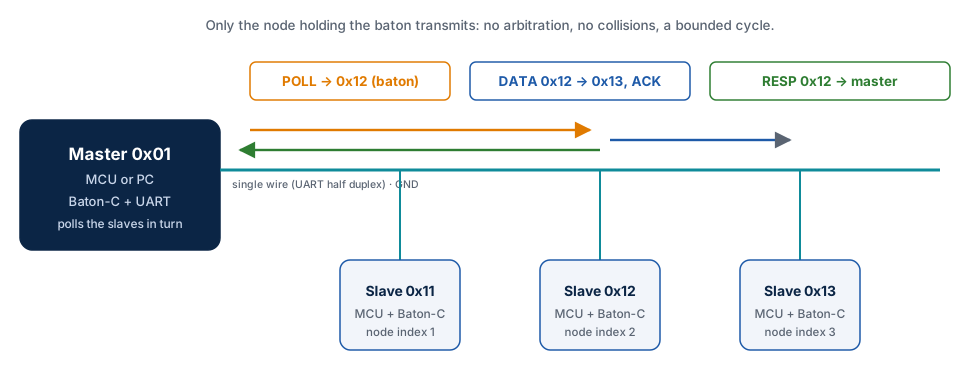
- The master polls the slaves in a fixed order. A
POLLframe grants the bus to one slave for one slot; the master also uses it to deliver its own messages. - Inside its slot, the polled slave sends
DATAframes to the master or to other slaves; each is acknowledged (ACK) frame by frame and retransmitted when needed. ARESPframe ends the slot and returns the bus. - Events (commands, reports) are queued, acknowledged, deduplicated and delivered exactly once, in order. An event that cannot be delivered within its time-to-live is reported to the sender with the nodes that missed it.
- States (a temperature, an uptime) are mailboxes: the latest value always arrives, intermediate values may be skipped, and they can never overflow a queue.
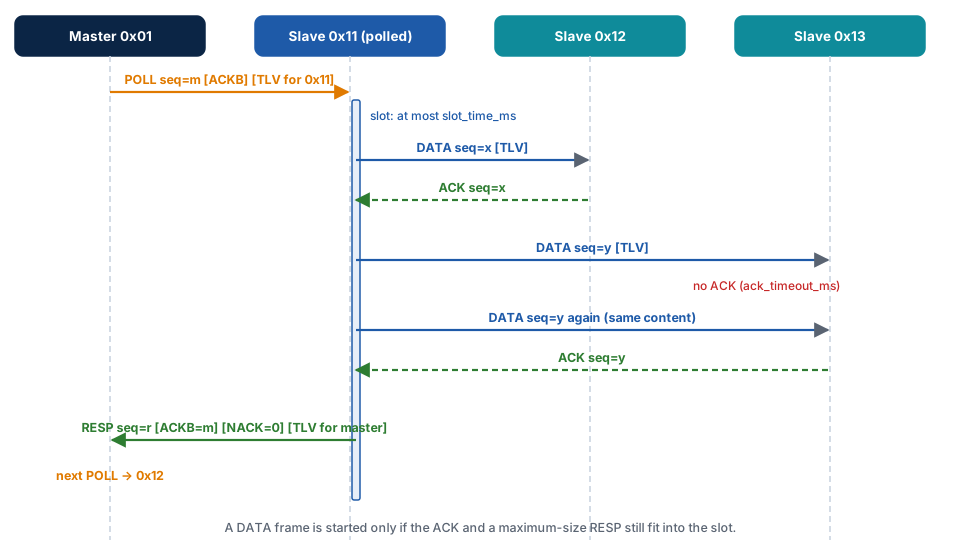
Because only one node transmits at a time, the worst-case cycle can be computed from the
configuration. The library itself has no heap, no RTOS, no clock reads and no global
state, reports 0 violations of the Cppcheck MISRA C:2012 addon, and has 100 % line and
branch coverage in its unit tests. What it does not have is any knowledge of hardware:
the application feeds it received bytes, starts transmissions and calls
baton_node_process() every millisecond. On Zephyr, that glue is exactly what a module
should own.
Why a Zephyr module, and not a driver
Baton is not a peripheral driver. It is a protocol stack on top of a UART, much like Zephyr's own Modbus serial support. So it follows the same shape:
- A west project. The repository carries
zephyr/module.yml; an application adds Baton-C to its manifest and nothing else. - A devicetree node under the UART with compatible
systemfromscratch,baton. The role, the addresses and the timing describe hardware topology, so they belong in devicetree. Every enabled node becomes a Zephyr device with its own protocol thread, so one image can serve several buses. - Kconfig only for software choices: stack size, thread priority, processing period,
log level.
CONFIG_BATONturns itself on when a Baton node exists. - The library stays untouched. The core sources in
src/are compiled as they are; everything Zephyr-specific is one C file and one header inzephyr/.
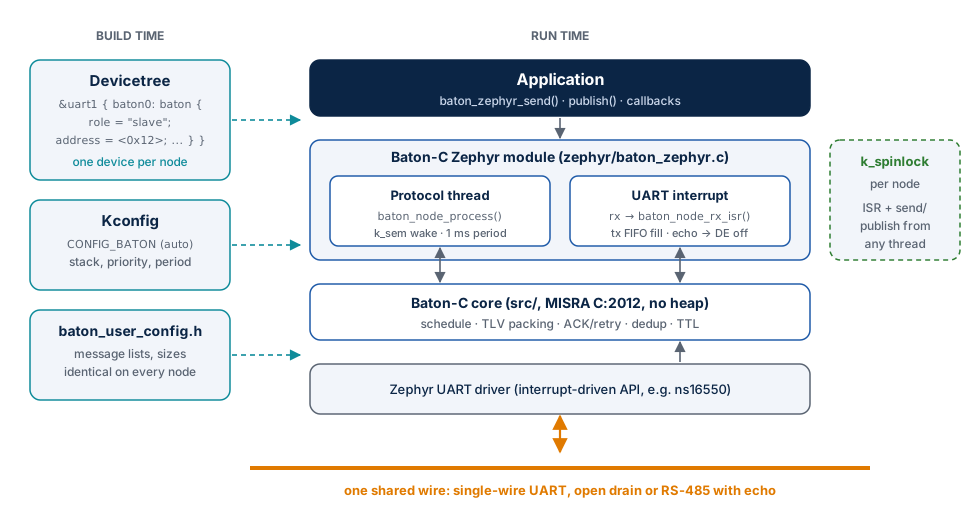
For the application, this is the whole integration:
    - name: baton-c
      url: https://github.com/AntonVynohradov/Baton-C
      revision: v1.1.0
      path: modules/lib/baton-c
&uart1 {
    status = "okay";
    current-speed = <9600>;

    baton0: baton {
        compatible = "systemfromscratch,baton";
        role = "slave";
        address = <0x12>;
        master-address = <0x01>;
        slave-addresses = [11 12];
    };
};
static const struct device* const bus =
    DEVICE_DT_GET(DT_COMPAT_GET_ANY_STATUS_OKAY(systemfromscratch_baton));

static void on_message(void* context, uint8_t src, uint8_t msg_id,
                       const uint8_t* data, uint8_t length)
{
    if ((msg_id == BATON_MSG_CMD_SET_OUTPUT) && (length == 2U)) {
        /* drive the output, then confirm to the sender */
        (void) baton_zephyr_send(bus, src, BATON_MSG_OUTPUT_REPORT, data, 2U,
                                 BATON_PRIO_HIGH);
    }
}

int main(void)
{
    const struct baton_zephyr_callbacks callbacks = {.on_message = on_message};

    return baton_zephyr_start(bus, &callbacks);
}
No interrupt handler, no ring buffer, no thread, no lock in the application. Compare that with the hand-written Zephyr example the library shipped before: about 200 lines of UART interrupt code, critical sections and a polling thread, repeated in every project.
Design decisions inside the module
The echo ends the frame. On a single wire, every node hears its own bytes. The
library already uses that echo to detect collisions; the module also uses the echo of
the last byte to know that the last stop bit has left the transceiver. That is the
moment to release an RS-485 driver enable (de-gpios) and it needs no "transmit
complete" interrupt. Those interrupts behave differently on almost every UART.
One spinlock per node. The UART interrupt and the library's critical-section hooks
take the same k_spinlock. baton_zephyr_send() and baton_zephyr_publish() are
therefore safe from any thread, on single-core and SMP systems alike.
A thread that sleeps, but not too long. Each node's thread runs
baton_node_process() and then waits on a semaphore with a 1 ms timeout. Received bytes
and new messages give the semaphore, so the node reacts immediately without
burning CPU while the bus is idle.
Errors as errno. The library's BATON_ERR_* codes become -ENOBUFS, -EMSGSIZE,
-EADDRNOTAVAIL and friends, so Zephyr code handles them like any other API.
Fail the build, not the bus. Baton times a 2 ms bus gap and a 5 ms inter-byte
timeout in milliseconds. While porting, it turned out that the board used for the
bring-up configures a 10 ms system tick, which would silently stretch every timeout
by up to a whole tick. The module now refuses to build with a tick coarser than 1 ms and
says which option to set. One BUILD_ASSERT replaces a debugging session in front of
an oscilloscope.
Two Zephyr versions, one source. Zephyr 4.5 changed the return type of
uart_irq_update() from int to void. The interrupt handler calls it as a statement,
so the same code builds on Zephyr 4.2 and on the current main.
Testing a bus without a bus
A bus protocol is only as good as its behavior when things go wrong, and that is hard to
provoke on a bench on demand. So the first target of the module is not a board but
native_sim: Zephyr compiled as a Linux program.
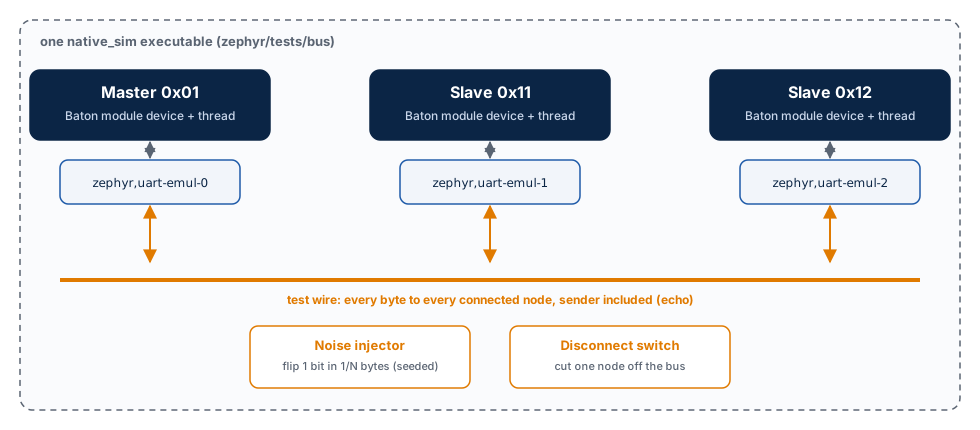
The test image contains three Baton nodes: the master and two slaves, each a regular
device of the module on its own emulated UART (zephyr,uart-emul). A few lines of test
code join the three UARTs into one wire: every byte a node transmits reaches every
connected node, including the sender, just like the echo on a real single wire. The
wire can flip bits with a seeded random pattern and can disconnect a node. The module
under test is byte-for-byte the code that runs on the board.
| Test | What it proves |
|---|---|
| State reaches every node | A value published by one slave arrives at the master and the other slave, and not back at itself |
| Events, master to slave and slave to slave | 60 numbered events, each delivered exactly once and in order |
| Noisy line loses nothing | About 1 byte in 150 corrupted: retransmissions deliver all 200 events |
| Heavy noise: every loss is reported | About 1 byte in 40 corrupted: some events exceed their time-to-live, but none is duplicated or reordered, and every one that is not delivered is reported to its sender |
| Disconnected slave | The master reports the silent slave and the undeliverable event, the rest of the bus keeps working, and the slave is served again after it is reconnected |
The suite runs with five different noise patterns on every push (west twister, 40 of
40 test cases passing). The numbers from the run that this article quotes:
| Noise pattern | Moderate noise: corrupted bytes, CRC errors, events lost | Heavy noise, master→slave: delivered + reported lost | slave→master |
|---|---|---|---|
| default | 14, 20, 0 of 200 | 100 + 7 | 93 + 7 |
| seed 7 | 17, 28, 0 of 200 | 100 + 0 | 100 + 3 |
| seed 42 | 11, 18, 0 of 200 | 93 + 22 | 80 + 20 |
| seed 1234 | 20, 32, 0 of 200 | 84 + 42 | 62 + 42 |
| seed 31337 | 14, 24, 0 of 200 | 100 + 0 | 100 + 0 |
Two things are worth reading in that table. Under moderate noise nothing is lost: corrupted frames fail their CRC and are retransmitted. Under heavy noise the protocol does not pretend: events that miss their deadline are dropped and reported. The sum "delivered + reported" is at least the number sent, and it can be higher, because an event whose acknowledgement was destroyed is delivered and still reported as unconfirmed. "No lost messages" means no silent loss: the application always knows.
All tables are generated from the twister reports by a script; the raw data is in the evidence.
On silicon: Microchip SmartFusion2
The hardware target is the Microchip M2S010 MKR Kit: a SmartFusion2 SoC FPGA whose microcontroller subsystem is an Arm Cortex-M3, clocked at 100 MHz in the board's devicetree. I contributed the Zephyr support for this board; it ships with Zephyr 4.5. The module talks to the bus through MSS UART1 (the console stays on UART0); on SmartFusion2, which pins that UART uses is decided by the FPGA design in Libero, so it is enabled by the application's overlay, not by the board.
The firmware is built in a reproducible container, derived from my Zephyr SmartFusion2 workspace: the Zephyr SDK with only the Arm toolchain, west, and the Libero tools kept outside the container.
Item on Cortex-M3 (-Os) |
Bytes |
|---|---|
Baton-C library code (src/) |
5 986 |
| Zephyr module glue, with logging | 1 598 |
| Node state with the example message lists | 1 256 RAM |
| Protocol thread stack (configurable) | 1 024 RAM |
| Complete sample firmware: text / data / bss | 29 348 / 188 / 8 204 |
Hardware measurements in progress
The sample builds without warnings for m2s010_mkr_kit/m2s010 in CI. Bring-up on the
board is in progress. This section will add the wiring, a logic-analyzer capture of
one poll slot, the measured cycle time against the computed one, the measured
thread stack usage, and the same fault-injection scenarios on a real wire.
Reproduce it
Everything in this article is reproducible from the article repository with a dev container or a local Zephyr setup:
west init -l article && west update -o=--depth=1 -n
article/scripts/test.sh            # bus test on native_sim + build for the board
python article/scripts/evidence.py # the tables of this article
See Reproduce for the details.
What's next
- Hardware results on the SmartFusion2 board, added to this page.
- Upstream. Baton-C is proposed to the Zephyr project as an optional module: a separate repository listed in Zephyr's optional manifest, with its samples and tests living in the module. The status is tracked on Upstream.
- RS-485 without echo. Transceivers that disable their receiver while transmitting need a "transmit complete" path in the module; the core library supports them already.
If you build devices where several MCUs share one wire, I would like to hear how you solve it today, and what Baton-C would need to fit your design.
Baton-C on GitHub · Documentation · Zephyr module guide · LinkedIn